
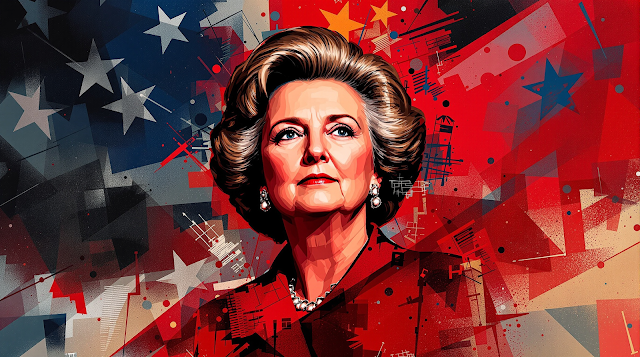
“If you want something said, ask a man; if you want something done, ask a woman.” – Margaret Thatcher.
“무언가를 말하고 싶다면 남자에게 물어보라. 무언가를 이루고 싶다면 여자에게 물어보라.” – 마가렛 대처.
The Iron Lady’s Perspective on Gender and Action
Margaret Thatcher (1925-2013) was a British stateswoman who served as Prime Minister of the United Kingdom from 1979 to 1990, becoming the first woman to hold this office and the longest-serving British prime minister of the 20th century. Known as the “Iron Lady” for her uncompromising leadership style and robust political views, Thatcher implemented policies known as Thatcherism—based on deregulation, privatization of state-owned companies, and reducing the power of trade unions. Her legacy remains controversial, with supporters crediting her with revitalizing Britain’s economy and critics arguing her policies increased social inequality.
마거릿 대처(1925-2013)는 1979년부터 1990년까지 영국의 총리로 재직한 영국의 정치인으로, 이 직위를 맡은 최초의 여성이자 20세기 가장 오래 재임한 영국 총리가 되었습니다. 타협하지 않는 리더십 스타일과 강력한 정치적 견해로 “철의 여인”으로 알려진 대처는 규제 완화, 국영 기업의 민영화, 노동조합의 힘 감소에 기반한 대처리즘으로 알려진 정책을 시행했습니다. 그녀의 유산은 여전히 논쟁의 여지가 있으며, 지지자들은 그녀가 영국 경제를 활성화시켰다고 평가하는 반면, 비판자들은 그녀의 정책이 사회적 불평등을 증가시켰다고 주장합니다.

The Power Behind Thatcher’s Famous Quote
“If you want something said, ask a man; if you want something done, ask a woman.” This bold statement by Margaret Thatcher encapsulates her perspective on gender dynamics and effective leadership. The quote cleverly contrasts stereotypical gender traits while asserting female competence and action-orientation. As a woman who shattered the ultimate glass ceiling in British politics, Thatcher’s words carried particular weight. While some might interpret the quote as dismissive of male capabilities, it more accurately reflects Thatcher’s pragmatic focus on results over rhetoric—a cornerstone of her governing philosophy. This statement also reveals her awareness of how women often needed to outperform their male counterparts to achieve recognition in traditionally male-dominated spheres.
“무언가를 말하게 하고 싶으면 남자에게 물어보고, 무언가를 하게 하고 싶으면 여자에게 물어보라.” 마거릿 대처의 이 대담한 발언은 성별 역학과 효과적인 리더십에 대한 그녀의 관점을 담고 있습니다. 이 인용문은 여성의 능력과 행동 지향성을 주장하면서 고정관념적인 성별 특성을 교묘하게 대조합니다. 영국 정치에서 궁극적인 유리 천장을 깨뜨린 여성으로서, 대처의 말은 특별한 무게를 지녔습니다. 일부는 이 인용문이 남성의 능력을 무시하는 것으로 해석할 수 있지만, 그것은 더 정확하게 수사보다 결과에 대한 대처의 실용적인 초점을 반영합니다—이는 그녀의 통치 철학의 초석이었습니다. 이 진술은 또한 여성들이 전통적으로 남성 지배적인 영역에서 인정을 받기 위해 종종 남성 동료들보다 더 뛰어난 성과를 내야 했다는 그녀의 인식을 보여줍니다.
Thatcher’s Personal Embodiment of Her Words
Thatcher’s career exemplified her own quote. Rising from humble beginnings as a grocer’s daughter to becoming Britain’s first female Prime Minister, she consistently demonstrated a preference for decisive action over empty rhetoric. During crises like the Falklands War and the miners’ strike, Thatcher’s resolute decision-making earned her both admiration and criticism. Her approach to governance was characterized by implementation rather than endless discussion—she famously declared “I am not a consensus politician, but a conviction politician” and “The lady’s not for turning.” These statements reinforced her image as someone who prioritized getting things done over merely talking about them, embodying the action-oriented leadership she associated with women in her famous quote.
대처의 경력은 그녀 자신의 인용문을 예시했습니다. 식료품점 주인의 딸이라는 겸손한 출신에서 영국의 첫 여성 총리가 되기까지, 그녀는 일관되게 빈 수사보다 결단력 있는 행동을 선호했습니다. 포클랜드 전쟁과 광부 파업과 같은 위기 상황에서, 대처의 확고한 의사 결정은 찬사와 비판을 모두 받았습니다. 통치에 대한 그녀의 접근 방식은 끝없는 논의보다는 실행으로 특징지어졌습니다—그녀는 유명하게 “나는 합의 정치인이 아니라 신념의 정치인이다”와 “이 여성은 방향을 바꾸지 않는다”라고 선언했습니다. 이러한 진술들은 단순히 그것들에 대해 말하는 것보다 일을 완수하는 것을 우선시하는 사람으로서의 그녀의 이미지를 강화했으며, 그녀의 유명한 인용문에서 여성과 연관시킨 행동 지향적 리더십을 구현했습니다.

The Contemporary Relevance of Thatcher’s Quote
Despite being spoken decades ago, Thatcher’s quote remains relevant in discussions about gender and leadership today. Modern research on leadership styles has found some evidence supporting the notion that women leaders often display more transformational leadership traits—focusing on implementation, collaboration, and getting results. However, unlike Thatcher’s era when female leaders were rarities, today’s landscape includes many powerful women in business, politics, and other fields who demonstrate diverse leadership approaches. The quote continues to resonate because it challenges persistent stereotypes while highlighting the practical effectiveness that marginalized groups often develop when they must work twice as hard to receive equal recognition.
수십 년 전에 말해졌음에도 불구하고, 대처의 인용문은 오늘날 성별과 리더십에 관한 논의에서 여전히 관련성이 있습니다. 리더십 스타일에 관한 현대 연구는 여성 리더들이 종종 더 변혁적인 리더십 특성—실행, 협력, 결과 도출에 초점을 맞추는—을 보여준다는 개념을 지지하는 일부 증거를 발견했습니다. 그러나 여성 리더가 희귀했던 대처의 시대와 달리, 오늘날의 풍경은 다양한 리더십 접근 방식을 보여주는 비즈니스, 정치 및 기타 분야의 많은 강력한 여성들을 포함합니다. 이 인용문이 계속해서 공감을 얻는 이유는 소외된 집단이 동등한 인정을 받기 위해 두 배로 열심히 일해야 할 때 종종 개발하는 실용적인 효과성을 강조하면서 지속적인 고정관념에 도전하기 때문입니다.
The Legacy of Thatcher’s Perspective
Margaret Thatcher’s quote about men saying and women doing represents more than just a clever aphorism—it reflects her lived experience as a pioneering female leader who valued action over words. While some may debate the gendered generalizations in her statement, the underlying message about the importance of implementation and results over empty talk remains powerful. As workplaces and political environments continue evolving toward greater gender equality, Thatcher’s perspective reminds us to evaluate leadership based on tangible outcomes rather than rhetorical skill. Her legacy, controversial as it remains, includes this enduring insight into the relationship between gender, communication, and effective action.
남성이 말하고 여성이 행동한다는 마거릿 대처의 인용문은 단순한 영리한 격언 이상을 나타냅니다—그것은 말보다 행동을 중시한 선구적인 여성 리더로서의 그녀의 살아온 경험을 반영합니다. 일부는 그녀의 진술에서 성별화된 일반화에 대해 논쟁할 수 있지만, 빈 말보다 실행과 결과의 중요성에 관한 근본적인 메시지는 여전히 강력합니다. 직장과 정치적 환경이 더 큰 성평등을 향해 계속 발전함에 따라, 대처의 관점은 우리에게 수사적 기술보다는 실질적인 결과를 기반으로 리더십을 평가하도록 상기시켜 줍니다. 논쟁의 여지가 있는 그대로, 그녀의 유산은 성별, 의사소통, 효과적인 행동 사이의 관계에 대한 이 지속적인 통찰력을 포함합니다.
